

Planning tonight’s dance class shouldn’t eat the night before you teach. Dance instructors run out of ideas in a specific way: 45 minutes, a mixed-age jazz class, and a combo that still has to land. This is for studio faculty, owners who still teach, and independent instructors.
Why dance class planning is a different job
A dance class is a live hour on a sprung floor. You are counting phrases, watching alignment, choosing music, and keeping a room of kids, teens, or adults moving. The plan is an order of events that has to survive tired bodies, a late arrival, and the fact that last week’s combo still needs cleaning.
That is why generic chatbot answers fall apart. Studio faculty need the next 8-count, a cleaner cue, a 5-minute warm-up that matches the style on the schedule, and sometimes a calm sentence for a parent waiting in the lobby.
If you teach ballet at 4:00, hip hop at 5:15, and a teen competition group at 7:00, you are switching rooms, ages, and musical worlds with almost no desk time in between.
What “out of ideas” usually means on the studio floor
Most instructors are not empty. They are overloaded. The ideas exist, but they are scattered across old notes, voice memos, and “I’ll remember that combination.” Out of ideas usually looks like one of these:
- You know the warm-up, and then the center work goes vague
- You have a combo, but no clear focus for the first 10 minutes
- The music is wrong for the age, the length, or the cleanliness you need
- You can see the correction, but you cannot say it in a way students will use
- A parent needs an update after a rough class, and your first draft is too long
The job is not to invent a brand-new pedagogy every night. The job is to walk into the room with one intention, enough material to fill the hour, and language that keeps the class moving.
A practical way to plan tonight’s class
Start smaller than a full syllabus. Pick the class on the schedule, style, age, and length, and decide one focus. Musicality. Weight transfer. Cleaner arms. A recital run-through that does not eat the whole hour. One focus is enough. Two focuses usually means neither gets taught.
Then sketch the hour in the order you will actually teach it:
- Open. 5–8 minutes. Pulse, breath, and the skill you named, in the body, not as a speech.
- Skill. 10–15 minutes. Across-the-floor or center work that repeats the focus on 8-counts.
- Combo or phrase. 15–20 minutes. Short enough to clean. Hard enough to feel like class.
- Apply. 5–10 minutes. Put the focus back into the phrase, or run a piece of recital / competition material.
- Close. 2–3 minutes. One sentence students can remember in the car.
If you only have ten minutes in the lobby before the next group, write the open and the combo. The rest can be familiar material with a sharper cue. A finished-looking document is not the goal. A class that has a spine is the goal.
Cues, combos, and the sentence students can use
Dance instructors lose time on language. You can see the correction, the standing leg, the delayed weight change, the arm that dies at the wrist, and still say something too long, too vague, or too technical for that age.
Useful cues are short enough to land between counts. They name the body part, the timing, and the next try. “Hold the standing leg through 5-6, then change.” “Start the arm on 1, not after the turn.” That is coaching, not a lecture.
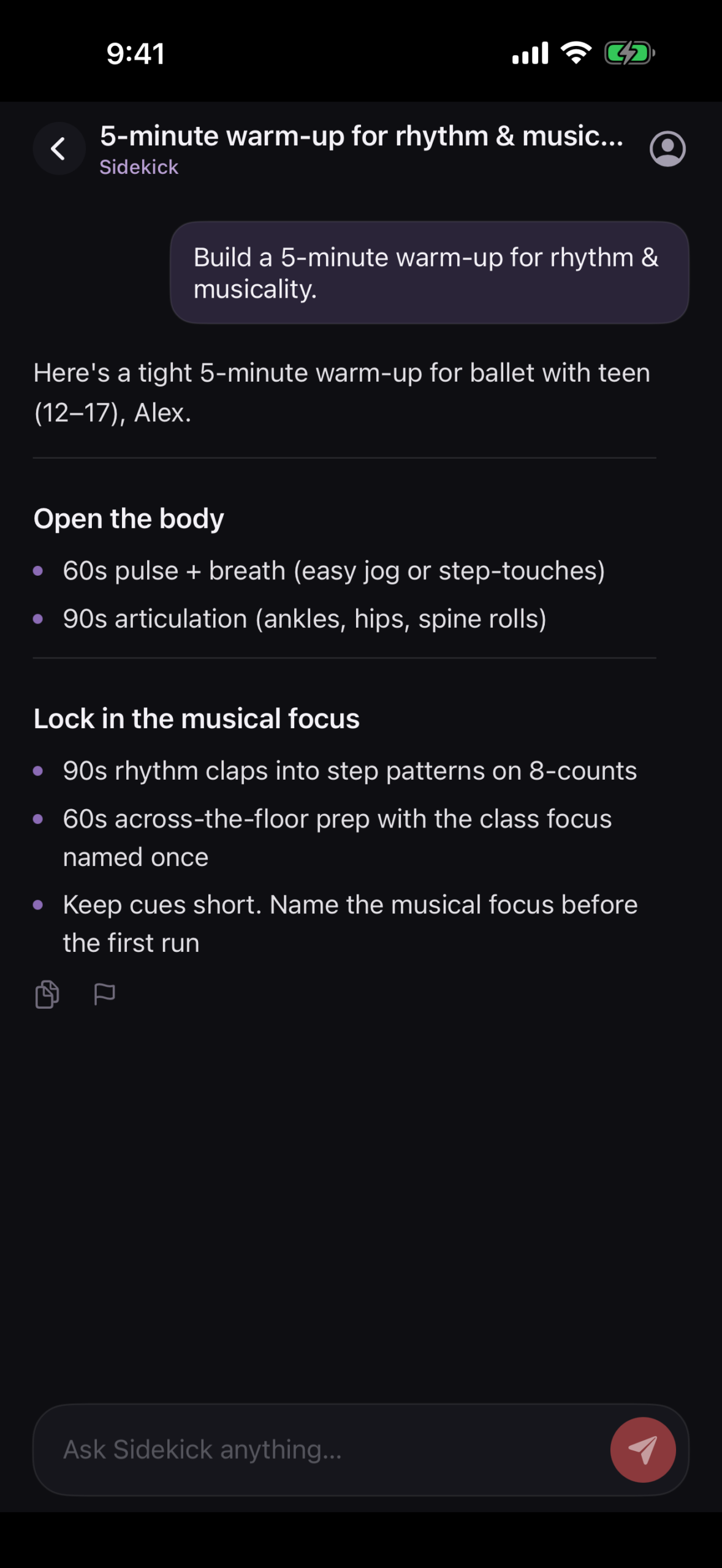
When you are stuck, ask for a combo with constraints you already know: style, age, length, and the focus. “Build a 5-minute warm-up for rhythm and musicality” is the kind of request that stays on the floor you actually teach.
Music is part of the plan, not a leftover tab
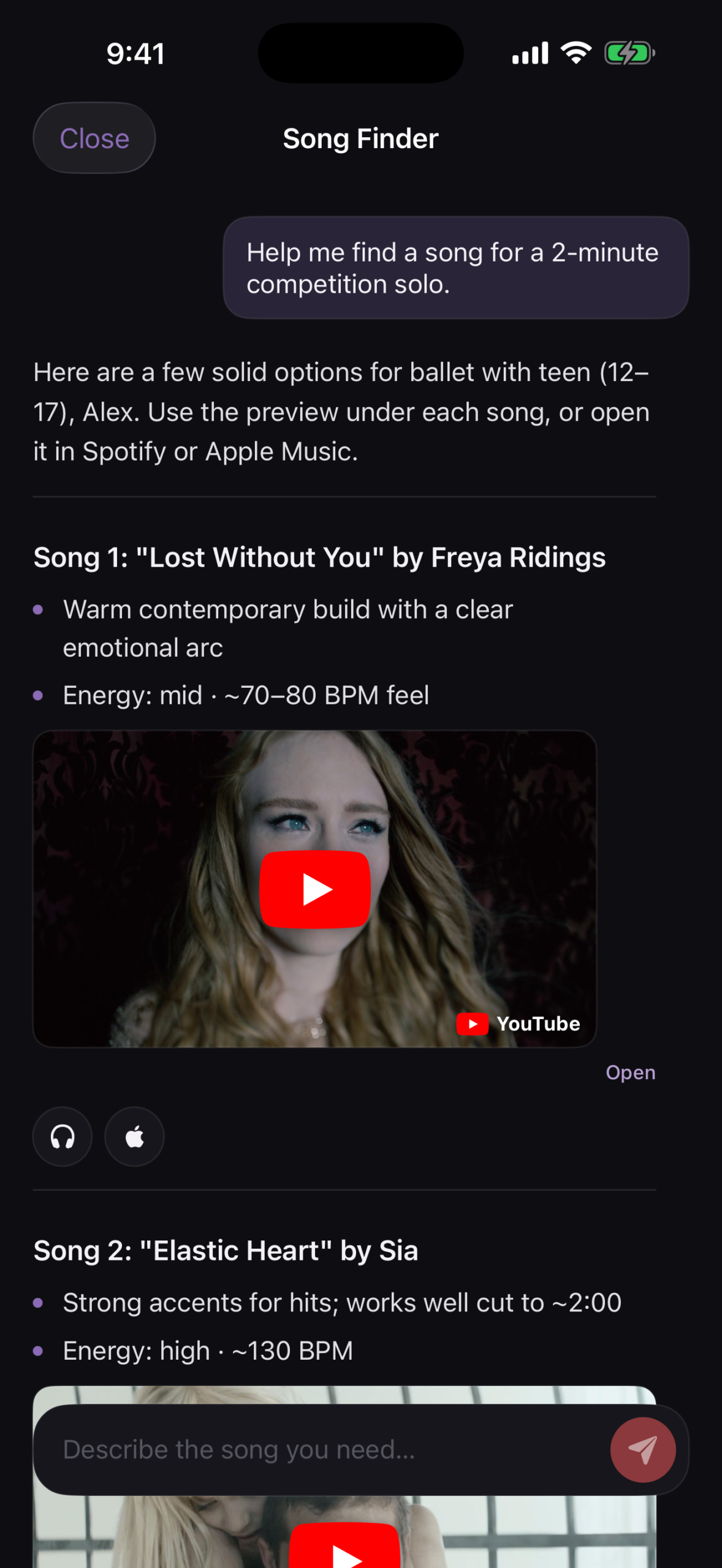
A lot of “I don’t know what to teach” is actually “I don’t have the track.” Class music, choreography music, and a 2-minute competition solo are different jobs. One needs even phrasing you can count. One needs an emotional arc. One needs a clean cut that matches the routine length.
Search in the apps you already use. Preview before you commit. If you already own the file, trim it to the length the piece needs instead of talking over an extra chorus. That is studio work: rights, length, and whether the lyrics belong in that room.
Parent messages after a tough class
Studio parents want to know their dancer is safe, seen, and working on something specific. After a hard class, a useful note is short: what you practiced, what you noticed, and the next skill. Warm, not defensive. Under five sentences if you can manage it.
If something looks like pain or injury, that is a different conversation with a qualified professional, not a paragraph you should invent at 10 p.m.
Where Sidekick fits
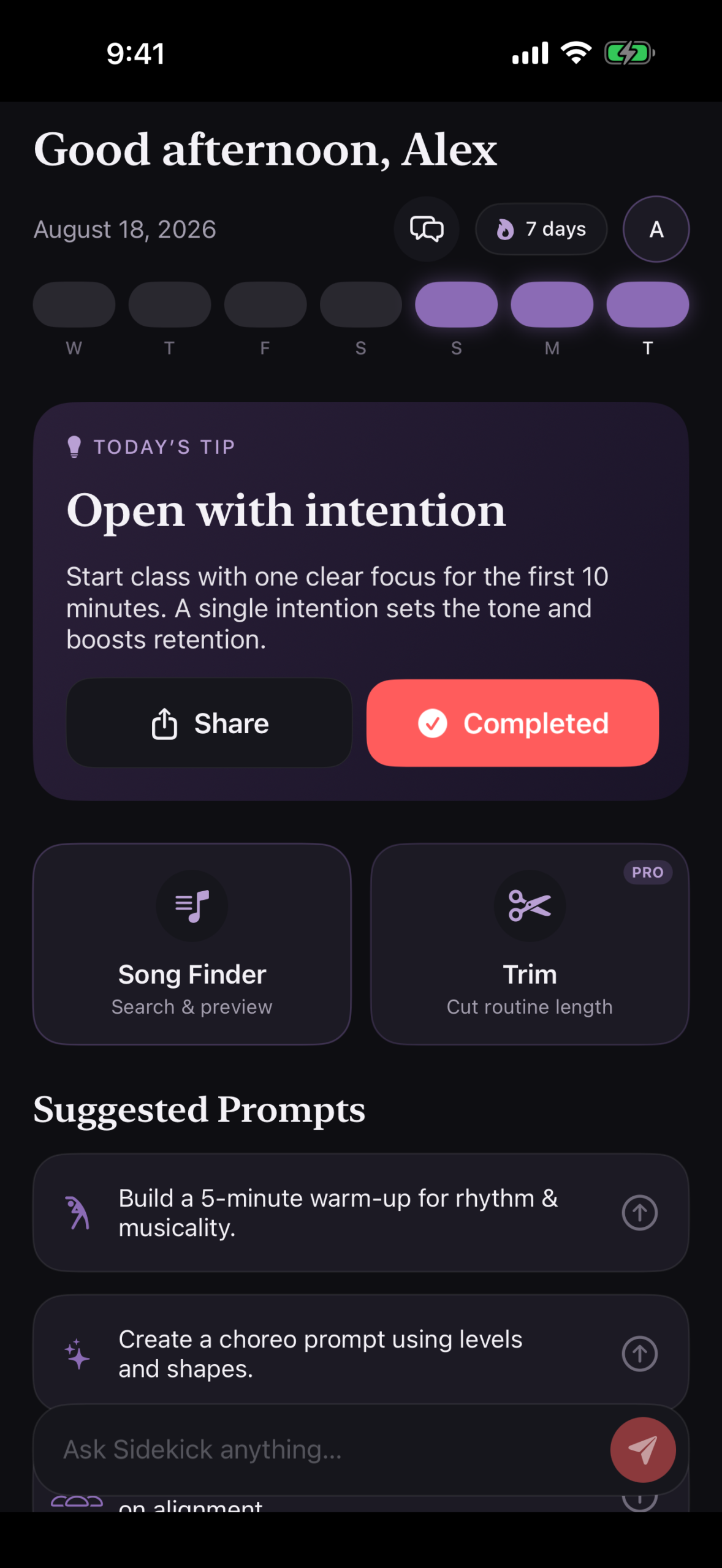
Sidekick is a daily helper for dance instructors and studio owners. It grew out of the gap above: a practical colleague for cues, combos, and parent messages, not another generic chatbot. You can open it between classes for a teaching tip, a class sketch, Song Finder, and, on Pro, import and trim for routine music.
It is free to try. The free app includes daily tips and a small number of messages each day. Sidekick Pro is optional if you want unlimited help, stronger teaching answers, and trim. Payment is handled by Apple.
Use it as a first draft you still review. You know the room. The app does not.
What this is not
It is not a learn-to-dance app for students. It is not studio billing, scheduling, or attendance software. Sidekick stays on the studio floor: the next class, the next cue, the next parent sentence, the next cut of the track.
A closing rhythm for the week
- Name one focus before you pick the combo
- Reuse last week’s phrase if it still needs cleaning
- Choose music while you still have energy, not after the class is already planned
- Write parent notes shorter than your first draft
- Stop while you can still walk into the room tomorrow
The night before class will always ask for more than it deserves. Give it a focus, a combo, and a track. Leave the rest for the floor, where the real teaching happens.
FAQ
Who is this for?
Dance instructors: studio faculty, owners who still teach, and independent teachers of kids, teens, or adults.
Does Sidekick teach students how to dance?
No. Students do not use it as a practice app. It is educational support for instructors. You still decide what goes into class.
Can it replace my syllabus or studio software?
No. Keep your curriculum, attendance, and billing where they already live. Sidekick is for the hour in front of you: ideas, cues, music, and communication.
What if I only have a few minutes between classes?
Ask for one piece, a 5-minute warm-up, a cleaner cue, a parent sentence, instead of a full rewrite of the hour. Review it, then teach.
Overview: Sidekick for dance instructors.